
You’re on a website trying to return something, and the only help available is a chat window in the corner.
You type your question. It replies with links to pages you’ve already read.
You rephrase. It asks if you’d like to speak to an agent… then tells you no agents are available.
Ten minutes later, you’re right back where you started and more frustrated than when you arrived in the first place.
Now… imagine a different experience: the chatbot knows that store’s return policy inside and out. It recognizes your order, understands what you’re asking and tells you exactly what to do next. If it can’t solve the problem, it hands you to a person who already has the whole conversation in front of them. One question, one clear answer, and you’re done.
The difference between those two experiences isn’t whether the business uses AI. It’s whether that AI was built for them. The first chatbot is generic: one tool made for thousands of businesses and dropped onto a website. The second was designed around that business, its information and its customers.
Most businesses start with the first kind, and it’s easy to see why. Someone hands the team a ChatGPT login, adds a ready-made chatbot to the website, or switches on the AI button inside a tool they already pay for. It’s right there, costs little or nothing to try, and it appears useful. The problem starts when a tool built for everyone is asked to do a job that’s specific to your business, especially one your customers see.
A generic tool doesn’t know your pricing, your standards, your products, or the customer who has been buying from you for ten years. Instead of saving time, your team ends up babysitting it, and your customers end up going around in circles.
A custom AI solution changes that. Here’s what it can do, and why it’s the better fit for anything your customers touch.
What You’ll Learn
- What custom AI solutions can do for your business
- How custom AI improves the experience for your customers and prospects
- What staying with generic AI costs you
- How generic AI and custom AI solutions compare
What Custom AI Solutions Can Do for Your Business
A custom AI solution starts with your business, not the software. Instead of asking your team to adapt to a generic tool, the tool is shaped around the job you need done. Here’s what that makes possible.
It Knows Your Business
A custom tool answers from the content you’ve approved: product details, pricing guidelines, specifications, ISO standards, past proposals, SOPs and FAQs. It follows your business rules, too. For example: if a lead is from the U.S. and mentions a $50,000 budget, it can route that lead to a senior partner and draft a proposal based on your most relevant case studies. No one needs to remember the rule – the tool applies it every time.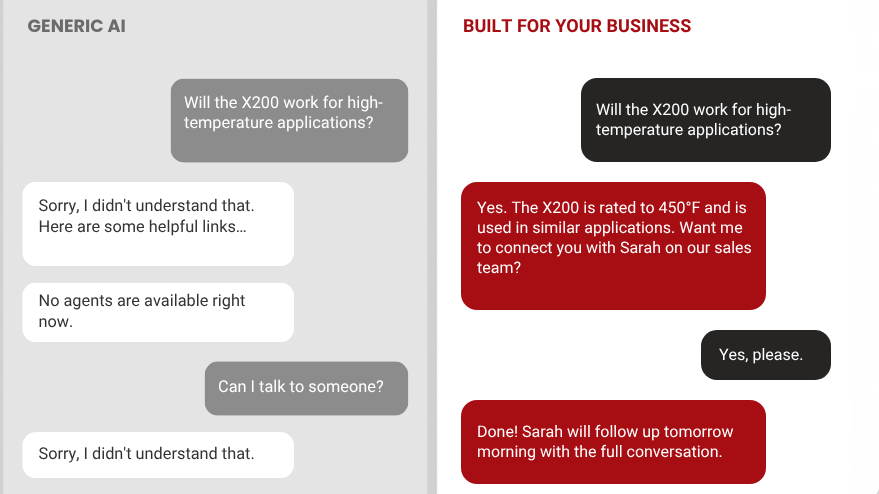
A generic tool is built for millions of businesses, so it doesn’t know any of this. When it’s missing something, it fills the gap with what it can find on the internet. Sometimes that’s close enough. Often, it’s generic, out of date or simply wrong, and it sounds confident either way.
It Gives Prospects the Depth They Need and Tells Your Story
Because it draws on your own information, a custom tool can answer the detailed questions prospects ask when they’re deciding: whether a product fits their application, how your process works, and what makes you different. It speaks in your brand voice and reflects your experience, the problems you’ve solved, and the reasons customers choose you.
A generic tool can provide information, but not the depth or insight a prospect needs to make a decision. It also can’t tell your story, so even when its answer is technically correct, it could have come from any of your competitors.
It Fits How Your Team Already Works
A custom tool connects to the systems your team already uses, like your CRM, inbox, forms and documents, so information moves without copy-and-paste and every conversation has context. Results stay consistent because the tool follows the same rules no matter who is using it.
Generic tools don’t talk to your other systems. Your team copies information in, copies answers out, and fills in what the tool missed, which creates new silos instead of removing old ones. And because different people prompt in different ways, results change from one person to the next.
It Knows When to Hand Off to a Person
A well-built tool knows what it shouldn’t answer and when to pass the conversation to someone on your team, with the full history so the customer doesn’t have to start over.
A generic chatbot often has no handoff at all, or one where the customer has to repeat everything. That’s the loop from the start of this article.
How Custom AI Improves the Customer Experience
Put your own prospect in that chat window from earlier. It’s 9 p.m., and they have a specific question about whether your product will work for their application.
With a generic chatbot, they get a friendly, general answer about “many factors to consider” and a suggestion to contact your team. They don’t. They go back to their search results and find a supplier who answered the question.
With a custom AI solution, the chatbot knows your product specs and application guidelines. It answers the question, explains why, and offers to connect them with the right person on your team, with the conversation already logged. The prospect gets what they came for, and your team starts the next day with a qualified lead.
The same goes for follow-up. An email your sales rep automates with ChatGPT is polished and professional… but it’s also nearly the same email the prospect received from two other vendors that week. A custom tool drafts follow-ups from your own case studies, past conversations and CRM history, so the message sounds like you and speaks to that prospect.
B2B buyers do much of their research before they ever speak to you. Specific, helpful answers early on show them you know your business and care about theirs.
Custom AI in Action: The Benefits Trust
The Benefits Trust worked with Core to launch a custom AI support agent that now handles more than 350 chats a month. As President Robert Crowder put it: “This tool has become both a reliable support tool and a valuable sales resource for our team… It’s improved the customer experience while saving our team valuable time.”
Custom AI doesn’t have to mean a big, complicated rollout. Starting with one well-defined workflow is often the smartest way to prove the value and build from there.
What Staying with Generic AI Costs You
Generic AI looks like the cheaper choice, but it comes with costs of its own:
- Lost prospects. Answers that don’t answer the question send buyers to the competitor who did.
- A business that sounds like everyone else. Vague or templated interactions read as “this company doesn’t know” or “this company doesn’t care.” Neither is the impression you want to leave.
- The edit tax. If your team spends 20 minutes fixing something AI produced in 10 seconds, you haven’t gained efficiency. You’ve just changed the nature of the work.
- Inconsistent standards. Results depend on whoever happened to use the tool that day.
Generic AI vs. Custom AI Solutions
The technology behind both can be similar. The difference is whether it has been shaped around your business.
| Feature | Custom AI Solution | Generic AI |
|---|---|---|
| Knows your business | Your approved content, pricing, specs, SOPs and past proposals | Public internet and whatever you paste in |
| Customer questions | In-depth, specific answers that help a prospect decide | Surface-level answers; may guess when unsure |
| Handoff to a person | Routed to the right person with the full conversation | Often none, or the customer starts over |
| Brand voice and story | Reflects your tone, experience and what makes you different | Sounds like every other vendor |
| Consistency | Rules-based and repeatable | Varies by prompt and user |
| Connected systems | Works inside your CRM, inbox, forms and documents | Copy-and-paste between tools |
| Data privacy | Configured for your data and access rules | Depends on the plan and settings |
| Results | Measurable gains on a specific workflow | Small, scattered time savings |
If a prospect could get the same answer from your competitor’s chatbot, your AI isn’t helping you win.
Close the Strategy Gap
A custom AI solution gives specific answers, tells your story, and fits naturally into how your team works. That’s the difference between a tool that knows your business and one that doesn’t. Generic AI is still fine for brainstorming, but anything your customers and prospects touch deserves a tool built for them.
Is generic AI talking to your customers? If your chatbot gives surface-level answers or your team spends more time fixing AI drafts than using them, let’s discuss how we can improve your processes. We’ll help you find where a tool built for your business would make the biggest difference.
Frequently Asked Questions About Custom AI Solutions
What makes a custom AI tool different?
A custom AI tool is built around a specific job in your business. It follows your business rules, draws on your own information, connects to the systems you already use and includes guardrails for what it should and shouldn’t do. The result is consistent, on-brand help that fits naturally into your workflow.
Is custom AI only for large companies?
No. Many small and mid-sized businesses start with one focused workflow, such as a website chatbot or lead intake, and a clear goal. That keeps the first step manageable and makes it easier to see the value before expanding into other areas.
Is ChatGPT enough for my business?
ChatGPT is useful for brainstorming, drafting and general research, but it isn’t built around your business by default. It doesn’t know your products, pricing, customers or processes. For anything your customers or prospects see, a custom solution shaped around your workflow gives more accurate, consistent and useful results.
Why does a generic AI chatbot give vague answers?
Generic chatbots are designed to work for many businesses, so they rely on limited information, often pulled from your website or the wider internet. When they don’t have a specific answer, they give a general one. A custom chatbot is grounded in the content you’ve approved, so it can answer specific questions and knows when to hand off to your team.

- Why Generic AI Can Turn Off Your Customers and Prospects - October 6, 2026
- How Core Helps Canadian Businesses Identify, Plan, and Implement AI - September 27, 2026
- How a Personal Injury Law Firm Uses AI to Qualify the Right Cases and Support Clients Around the Clock - September 25, 2026