
As large language models reshape how buyers research solutions online, you may find yourself with an issue. Your website ranks well in traditional search yet remains invisible in AI-generated answers. How does that happen?
Before jumping to conclusions, it helps to understand how AI search works.
AI systems don’t rank pages the way traditional search engines do. Instead of focusing primarily on keywords and backlinks, they evaluate:
-
- Topical authority
- Entity clarity
- Content structure
- Website credibility
- Relationships between concepts on a page
Schema markup is one signal among many that helps reinforce those factors. To be clear, you don’t need schema for AI systems to read your website. They can interpret plain content. However, structured data reduces ambiguity and increases confidence in how your information is classified.
Without clear signals, AI may misinterpret sections of your site, struggle to identify services or expertise, or overlook your organization entirely. With structured schema in place, you provide explicit context about who you are, what you offer, and how your content connects to specific topics.
Businesses invested in their digital transformation need to understand how schema for AI search works and how to implement it correctly to use it to their advantage. This guide explains what schema markup is, why it matters for AI-driven search, and how to structure your website to improve visibility in LLM-powered environments.
What You’ll Learn
-
-
- What schema markup is and why it matters
- How schema for AI search is different from traditional SEO
- How to implement schema on your website
- The advantage of using schema markup for AI search
-
What Is Schema Markup?
Schema markup is structured data added to a website’s code that helps search engines and AI systems understand the meaning of your content. Instead of guessing what a page represents, machines receive explicit context about information on each webpage, including organization info, products, services, authors, and more.
Schema.org, the standardized vocabulary supported by major search engines, defines how structured data is formatted and interpreted. We recommend digging into their website to get a deeper understanding of how markup classifies content into recognized entity types.
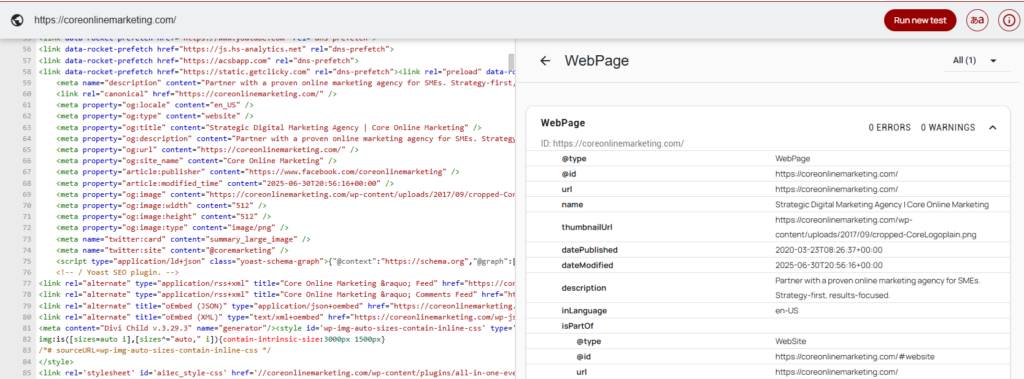
A visual of what schema markup looks like in Google Rich Results Test.
Why does schema matter in AI search?
AI search doesn’t “read” your page the same way a person does. Instead, it predicts the meaning of the content based on patterns, probability, and context. Schema markup reduces ambiguity in that prediction process, increasing certainty and confidence about the information being presented.
Without schema, AI has to infer. For example, consider the following. When an AI looks at a page without schema, it has to ask:
-
- Is this paragraph describing a service?
- Is this a definition?
- Is this the company’s mission?
- Is this a testimonial?
- Who authored this content?
Assumptions introduce uncertainty, which AI is designed to avoid. If an AI system cannot confidently determine what your content represents, it may choose not to reference it at all. In other cases, it may summarize the content inaccurately because it misinterprets the context.
Schema markup removes that guesswork by explicitly labelling content. Instead of AI guessing, “This looks like a service,” schema tells it, “this is a service entity. Here are its name, description, provider, and area served.” That information improves accuracy and increases the likelihood that your content will be surfaced in AI-generated answers.
Core Schema Types for LLM Visibility
Implementing schema for LLMs requires focusing on high-impact entity types. Not every schema type contributes equally to AI visibility. Here are a few to focus on.
Organization Schema
Organization schema defines your company as a distinct entity. This schema data includes:
- Business name
- Logo
- Contact information
- Service areas
- Links to authoritative profiles
This strengthens knowledge graph associations.
Article and Author Schema
LLMs assess credibility. When combining article schema with author schema, your page will clarify:
- Who wrote the content
- Their expertise
- Publication dates
- Topic alignment
For business owners evaluating providers, visible authority signals influence trust.
Service Schema
For B2B organizations, the service schema explicitly defines offerings, descriptions, and industries served. This is critical for AI systems determining relevance to user queries.
FAQ Schema
When structured properly, FAQ schema organizes question-and-answer content into machine-readable segments. This improves the likelihood that AI systems extract accurate, contextual responses. This is critical for the question-based approach that AI search takes, and how many tools like ChatGPT quote direct answers to questions.
How to Implement Schema Markup for LLMs
So, now you understand how important schema markup is for AI search, it’s time to ask – how do I include it on my site? Implementing schema markup doesn’t require rebuilding your site, but it does require some changes.
There are three ways to add schema to your website, and the right method depends on your CMS, technical comfort level, and overall strategy.
1. Use JSON-LD Format
This is the most flexible format and is recommended by Google because it separates content from markup and is easier to maintain.
JSON-LD is a block of structured data written in JavaScript format, placed inside the <head> section of a page. It doesn’t affect how your page looks, but provides structured direction for machines. You can add JSON-LD directly in your website’s <head> section, via your CMS theme header file, through a tag manager, or through a schema plugin.
2. Use a CMS Plugin
If your site runs on WordPress, Shopify, or another CMS, plugins are available to easily implement schema markup.
Examples include Rank Math, Yoast SEO, and Schema Pro.
These tools automatically generate organization schema, article schema, FAQ schema, and service schema.
3. Hardcode Schema for Key Pages
For strategic pages like:
- Services
- About
- Blog pages
- Author bios
- FAQs
You can add page-specific schema manually. This helps explicitly connect information so AI can understand the relationship.
Use structured data testing tools to confirm markup accuracy. An incorrect schema can reduce clarity rather than improve it.
Validate Your Schema
After adding schema to your site, be sure to test it. Use tools like Google Rich Results Test or Schema Markup Validator to confirm that syntax is correct, entities are properly structured, and no critical errors exist. If schema is implemented incorrectly, it can reduce clarity, making it even more difficult for AI to navigate.
The Strategic Advantage of Schema Markup for AI Search
AI search visibility is becoming a competitive differentiator. Businesses that structure their content clearly provide AI systems with confidence signals. That confidence influences whether your organization appears in summaries, citations, and AI-generated responses.
Structured schema supports:
- Clear entity recognition
- Improved content extraction
- Stronger authority positioning
- Alignment with evolving search behaviour
For SMEs focused on sustainable growth, ignoring schema markup for AI search creates risk. Competitors who invest in structured content gain a measurable advantage in emerging search environments.
AI systems reward clarity. Structured data is how you provide it.
Final Thoughts
Implementing schema for AI search isn’t a one-time technical task. It’s part of a broader online marketing plan to support long-term revenue growth.
If you want to understand how well your website is positioned for AI visibility, the next step is a call with us. Our team can review your current performance and help you determine if a digital marketing plan is the right fit for you.

- Why Generic AI Can Turn Off Your Customers and Prospects - October 6, 2026
- How Core Helps Canadian Businesses Identify, Plan, and Implement AI - September 27, 2026
- How a Personal Injury Law Firm Uses AI to Qualify the Right Cases and Support Clients Around the Clock - September 25, 2026