
A procurement manager needs three new suppliers. A year ago, she would have searched Google, opened a dozen tabs and spent an afternoon comparing websites. Today, she types one request into an AI assistant: “Find three suppliers in Ontario who can meet this spec, ship within four weeks and have ISO certification. Compare them.”
In under a minute, she has a shortlist, and she hasn’t visited a single website. If your company wasn’t on that list, you never knew you were in the running.
This is agentic commerce, and it’s already changing how businesses get found, generate leads and win new customers. As AI takes on more of the buying process, the businesses that come out ahead will be the ones AI can easily find, understand and recommend, and that respond quickly when a buyer reaches out. The good news is that you don’t need to be an AI expert to prepare, because most of what matters comes down to clear information, a well-built website and fast follow-up.
What You’ll Learn
- What agentic commerce is, in plain terms
- How AI is changing the way buyers find and choose suppliers
- What it means for your online visibility, leads and new customers
- Four practical steps to make sure AI recommends your business
- Where to start improving your AI visibility
What Is Agentic Commerce?
Agentic commerce is when AI tools research, compare and act on buying decisions for people or businesses. Instead of a person searching Google and browsing websites, AI builds the shortlist of suppliers, requests quotes and, increasingly, completes purchases. For your business, it means being clear enough for AI to understand and recommend, and ready to respond when buyers reach out.
The term comes from AI agents. An AI agent is a tool that doesn’t just answer a question but completes a task for you, such as finding suppliers or requesting a quote. You’ve likely used early versions already: ChatGPT, Gemini, Copilot, Claude and Perplexity can all research vendors and recommend a short list of companies in seconds.
The next step is already underway. Companies like OpenAI, Google and Stripe are building the tools that let AI complete purchases safely on a buyer’s behalf, which is a clear signal of where buying is headed.
What’s the Difference Between AI-Assisted Buying and Autonomous Purchasing?
Agentic commerce shows up in two ways, and most B2B buying sits in the first today. AI-assisted buying is already here: buyers use AI tools to research and compare suppliers, then make the decision themselves.
Autonomous purchasing goes a step further. The buyer gives AI a task and a set of rules, such as “reorder packaging when stock drops below 500 units, from approved suppliers, under $8,000,” and AI handles the order.
| AI-assisted buying | Autonomous purchasing | |
|---|---|---|
| What it needs from you | Clear, accurate, structured information | Everything above, plus systems that can respond, quote and transact |
| Where it is today | Widespread and growing fast | Emerging, starting with routine and repeat purchases |
For most businesses, the takeaway is the same either way. Clear information gets you recommended today, and fast, reliable responses will matter more as AI takes on more of the buying.
How Is AI Changing the Way Buyers Find Suppliers?
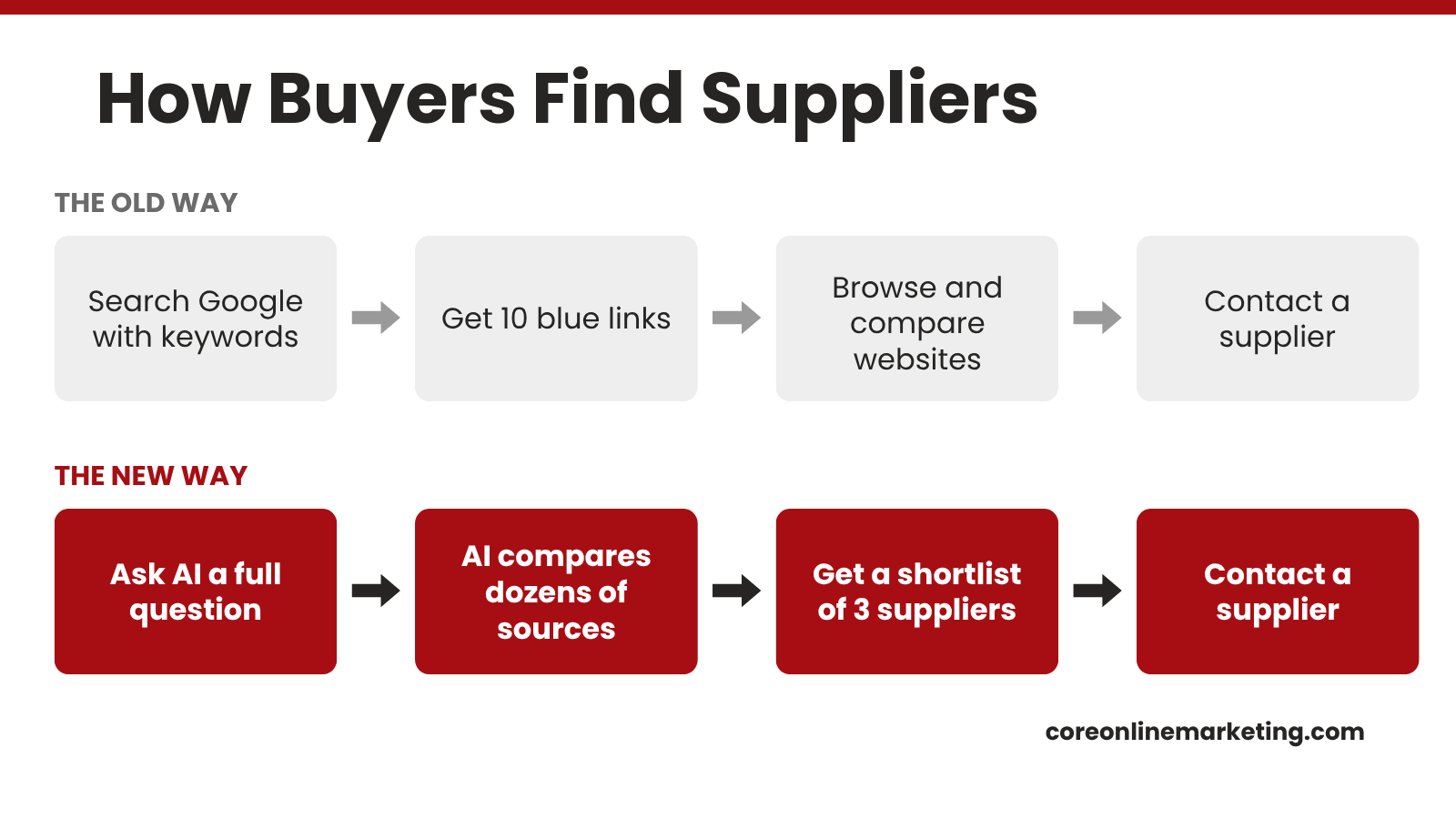
For 20 years, getting found online meant matching phrases. A buyer typed “industrial coating supplier Toronto,” Google returned ten blue links, and the buyer did the comparing. Your job was to rank for the right words and make a good impression once someone clicked.
That model is breaking down. B2B buyers already do most of their research before they contact sales, and more of that research now happens inside AI tools. Instead of short keyword searches, buyers ask full questions. The AI reads dozens of sources, synthesizes them, and hands back one answer. Even Google has moved this way with AI Overviews and AI Mode.
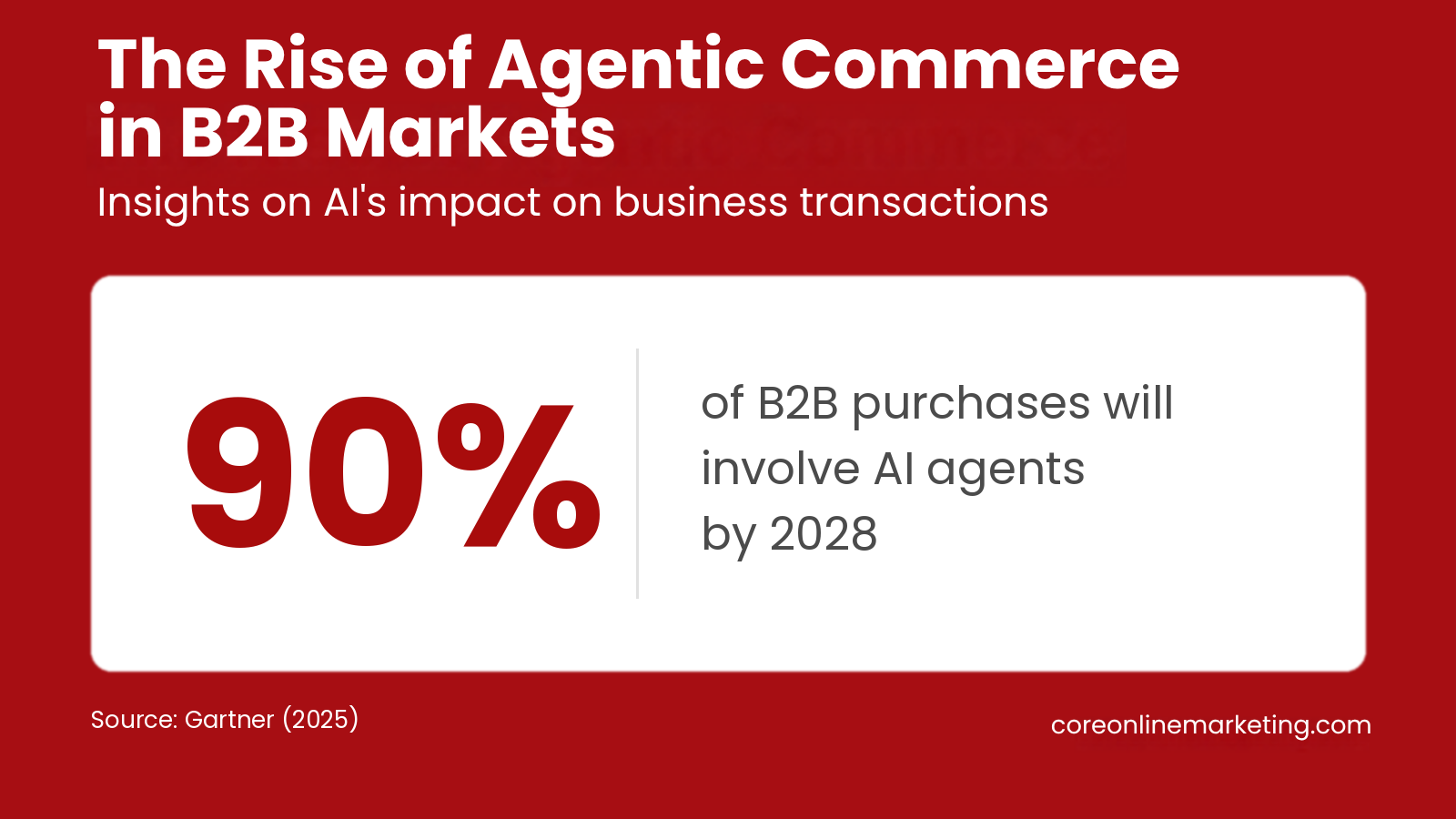
The shift is happening quickly. Gartner predicts that by 2028, AI agents will be part of about 90% of B2B purchases. In practical terms, most of your future customers will use AI somewhere in their search for a supplier, whether or not they ever mention it.
What Does Agentic Commerce Mean for Your Business?
For most business owners, the impact shows up in three places: whether buyers can find you, how many leads you get and whether you can win new customers.
Your online visibility
If AI tools can’t find clear information about your business, they leave you off the shortlist. Unlike a low Google ranking, you can’t see this happening. There’s no second page of results to check, so a buyer may never learn your business exists.
Your lead generation
AI tools don’t browse your website the way a person does. They pull out key facts and summarize them. If your important information is buried in long paragraphs, locked in PDFs and images or described in vague marketing language, AI may skip you or describe your business incorrectly.
Many business owners are feeling this without knowing the cause. The website looks fine and the marketing budget hasn’t changed, but inbound leads have slowed or dropped in quality. Often the reason is simple: the AI tools buyers use to build their shortlist can’t read your site clearly, so they recommend a competitor that is easier to understand.
The leads that do reach you will also look different. Buyers who research with AI tend to contact you later in their process, already knowing what they need and comparing only a few options.
Your ability to win new customers
There’s an upside, too. AI tools don’t recommend businesses based on size or ad budget alone. They favour suppliers with clear, specific and consistent information, and a fast response, which gives well-prepared small and mid-sized businesses a real chance to be recommended alongside, or ahead of, larger competitors. The buying journey below shows how this plays out.
What Does a B2B Buying Journey Look Like When an AI Agent Runs It?
Here’s how an agentic buying journey could unfold for a mid-sized food processor that needs a new supplier of custom printed packaging.
- The brief. The operations manager tells the company’s AI purchasing agent: “Find a packaging supplier within 300 km that can produce 20,000 custom printed cartons a month, meets food-safety certification, and can deliver the first run within six weeks.”
- The search. The agent searches AI tools, supplier directories and websites. It finds 14 possible suppliers and pulls their capabilities, certifications, locations and reviews.
- The comparison. It filters out suppliers that don’t clearly list food-safety certification or minimum runs. Six remain. Two more drop off because their capacity and lead times aren’t published anywhere the agent can verify.
- The quote requests. The agent contacts the remaining four with structured requests for pricing, lead times, and samples. Two respond within the hour. One responds the next day. One never responds.
- The recommendation. The agent compares the responses and recommends one supplier, with a summary of why: best lead time, clear pricing tiers, strong reviews and a fast, complete reply.
- The decision. The operations manager reviews the recommendation, approves it, and the agent sends a purchase order for the first run.
Notice where suppliers were lost. Eight were cut because the agent couldn’t confirm basic facts. One lost because it never replied. The winner wasn’t necessarily the best supplier. It was the one that was easiest to evaluate and quickest to respond, and both of those are within your control.
How Can Your Business Compete When AI Joins the Buying Process?
Competing in agentic commerce comes down to four areas, and Core can help with each one:
- Get found: AI tools can find your business and describe it accurately.
- Be easy to choose: AI tools can confirm what you do, what you offer and what it costs.
- Respond faster: Your business can reply quickly when a buyer or their AI reaches out.
- Stay in control: You decide what AI can share, promise and approve on your behalf.
1. Get Found: How Do You Show Up When Buyers Ask AI?
Showing up in AI answers starts with two related practices:
- Generative engine optimization (GEO) makes your content easy for AI tools like ChatGPT and Gemini to find, understand, and mention when they answer a buyer’s question.
- Answer engine optimization (AEO) organizes your content so it directly answers the questions buyers ask, making it more likely to appear in AI answers and Google’s AI Overviews.
Both build on traditional SEO rather than replacing it, and we cover the fundamentals in our guide to AI search optimization. For agentic commerce, three things matter most:
Label your information clearly
Schema markup is behind-the-scenes code that labels the information on your website, such as your services, locations, certifications, reviews, and FAQs, so AI tools know exactly what each piece means. Our article on schema markup for AI search explains how it works.
Answer the questions buyers ask
AI tools are built to answer questions, so they favour content that answers questions clearly. That means headings written as questions, a direct answer in the first sentence or two, and supporting detail after. Think of every key page as a response to something a buyer would ask.
Say exactly what you do
When your services are described consistently, in plain terms and in the same places across your site, AI tools can understand and compare them accurately. Here’s what the difference looks like in practice:
| Before: written for browsing | After: clear for AI and buyers | |
|---|---|---|
| Service description | “We deliver innovative, customer-focused solutions that drive results for businesses across a wide range of industries.” | “We provide precision CNC machining for aluminum and stainless steel parts, with runs from 50 to 10,000 units and typical lead times of 3–5 weeks.” |
| Page heading | “Our Solutions” | “What CNC machining services do we offer?” |
| Certifications | Logo images in the footer | Listed in text and marked up with schema |
| Service area | “Serving clients everywhere” | “Serving Ontario, Quebec and the U.S. Northeast” |
For more on this, see our guide to AEO and AI visibility.
This is the work Core’s AI search optimization (GEO) services are built for. We review how AI tools describe your business today, fix the gaps in your website’s structure and content and monitor how your visibility changes over time. Not sure where you stand? Start with a free AI visibility assessment.
2. Be Easy to Choose: What Do AI Tools Need to Recommend You?
AI tools make decisions differently than people do. They can’t be won over by a great video or a clever headline. They look for facts they can verify and compare, and if that information isn’t available, they move on to a supplier that provides it.
- Clear capabilities: exactly what you do, what you don’t do, and who you serve best
- Key details: capacity, lead times, turnaround, minimum order quantities, and response times
- Proof of credibility: certifications, compliance standards, years in business, reviews, and case studies
- Pricing information: published prices where possible, or clear guidance such as starting rates, ranges, and what affects cost
- Service area and availability: where you operate and how quickly you can start
Pricing is often the sticking point. Many B2B companies don’t publish prices because every project is custom. While that’s understandable, it leaves AI with nothing to compare. You don’t have to publish a full price list; sharing ranges, starting points, or the factors that drive cost gives AI something concrete to work with.
These same details help human buyers too. Clear capabilities, timelines, and pricing guidance answer questions before a prospect has to ask, so the leads that reach you are better informed and more prepared to buy.
We’ve long said that your website should be your best salesperson. With agentic commerce, it’s selling to two audiences at once: the people making the final decision and the AI tools deciding who gets in front of them. A strategically built website serves both.
3. Respond Faster: How Do You Turn AI Interest into Real Leads?
Getting onto the shortlist doesn’t win you the business. In our example, one supplier made the shortlist and then lost because it never replied, and the winner was chosen partly for how quickly and completely it responded.
Whether an inquiry comes from a person or their AI, buyers expect quick answers, accurate information, and a clear next step. That depends on how your business handles leads, not just what’s on your website:
- Fast inquiry handling that responds within minutes, not days, including after hours
- A clear quote process with set inputs, pricing rules and turnaround times
- Consistent information so your website, sales team and other systems give buyers the same answers
- Clear hand-offs that route qualified opportunities to the right person quickly
How businesses can use their own AI agents
Soon, a buyer’s AI may contact your business directly with questions about pricing, availability, or capacity. Your business can have its own AI agent ready to answer, ask the right follow-up questions, and book a call with your sales team for anything outside its limits.
The same technology buyers use can work for you. With custom AI agents from Core, businesses can:
- Qualify new leads by asking the right questions before a sales rep gets involved
- Answer customer inquiries about services, availability and next steps, 24 hours a day
- Prepare quotes within approved pricing, ready for your team to review
- Support existing customers with order updates, reorder reminders and routine requests
These agents don’t replace your team. They handle the repetitive, time-sensitive work so your people can focus on relationships and complex deals. For example, we built an AI intake assistant for a personal injury law firm that answers prospective clients around the clock and helps staff focus on the right cases.
4. Stay in Control: How Do You Keep Your Team in Charge?
Letting AI interact with buyers raises fair questions about what it can share, what it can promise, and who approves the final deal. The answer is to set clear rules before it starts:
- Pricing limits: AI quotes only within approved ranges, and anything outside them goes to a person.
- Information boundaries: You decide what is public, what is shared only with qualified buyers and what stays private, such as margins and client data.
- Approval points: Your team signs off on larger orders, custom terms and anything outside the norm.
Set up well, AI makes your business faster without making it riskier, and your team stays in charge of the decisions that matter. Core can help you define these rules before any AI tool goes live.
Where to start improving your AI visibility
- Find out how AI sees you today: start with Core’s free AI visibility assessment to see how AI tools describe your business, paired with a review of your website.
- Fix the foundation: improve your website’s structure, content and schema through our AI search optimization (GEO) and website development services.
- Speed up your response: tighten inquiry handling, quote processes and lead follow-up so no opportunity slips through.
- Add AI agents with clear rules: bring in custom AI tools where they’ll save the most time, with approval rules built in.
Why a Long-Term Partner Matters in Agentic Commerce
Agentic commerce isn’t a one-time fix. AI tools and buyer habits will keep changing, and your website and processes need to keep up. The businesses that come out ahead will treat this as an ongoing strategy, not a quick project.
That’s where the right partner makes a difference. Core Online Marketing has spent over 20 years helping B2B businesses grow online and more than three years building custom AI tools for our clients. Acting as your outsourced marketing team, we bring strategy, website development, AI search optimization (GEO), and custom AI under one roof, so every piece works toward the same goals.
AI search is the new frontier, but it’s still marketing. Trust, clarity and a plan tied to your business goals still win.
Frequently Asked Questions About Agentic Commerce
What is agentic commerce?
Agentic commerce is when AI agents research, compare and act on buying decisions for people or businesses. Instead of a person searching and browsing websites, AI evaluates suppliers, builds shortlists, requests quotes, and, increasingly, completes purchases. For businesses, being clearly understood by AI tools and ready to respond is now part of getting chosen.
How will agentic commerce affect my leads?
As more buyers use AI tools to research suppliers, fewer of them will browse your website before deciding who to contact. If AI can’t find clear information about your business, you may see fewer inquiries without an obvious cause. The leads you do receive will often be further along, already comparing a short list of options.
Is agentic commerce only for e-commerce and retail?
No. Retail is moving first, but B2B buying is following quickly. Gartner predicts that by 2028, AI agents will be part of about 90% of B2B purchases. Any company that relies on buyers researching suppliers online, including service firms and industrial suppliers, is affected.
How do AI tools decide which businesses to recommend?
AI tools recommend businesses whose information is clear, consistent and credible across the web. They favour websites with clearly labelled information (schema markup), direct answers to common questions, specific details like capabilities and service areas, and outside signals like reviews, directory listings, and mentions from trusted sources.
What is the difference between GEO and AEO?
Generative engine optimization (GEO) helps AI tools like ChatGPT and Gemini find, understand and cite your content in generated answers. Answer engine optimization (AEO) structures content to answer specific questions directly. They overlap heavily, and both build on SEO. Together, they make your business visible to AI-driven search.
What can a small or mid-sized business do now to prepare?
Start by checking how AI tools describe your business today, then make sure your website clearly states what you do, who you serve, where you operate, and how buyers can work with you. From there, focus on responding quickly to inquiries and adding AI tools where they save the most time. A free AI visibility assessment is a simple first step.
Does my website need schema markup?
Yes, if you want AI tools to understand your business accurately. Schema markup labels your services, location, reviews, and FAQs so AI tools can read them without guessing. It’s one of the most practical, high-impact steps you can take to improve AI search visibility and prepare for agentic commerce.
Do I need a new website to be ready for agentic commerce?
Not always. Many websites can be improved with schema markup, clearer page structure, and better content. However, if your site is outdated, hard to update, or built on a weak technical foundation, a strategic rebuild may be the faster and more cost-effective path. A readiness review will tell you which applies.

- What Is Agentic Commerce? What It Means for How Customers Find Your Business - November 2, 2026
- Why Generic AI Can Turn Off Your Customers and Prospects - October 6, 2026
- How Core Helps Canadian Businesses Identify, Plan, and Implement AI - September 27, 2026