
For most businesses, increasing output requires an increase in headcount.
This model may have worked in the past, but in today’s hyper-competitive environment, relying on hiring for growth is a liability. The Human Tax, the time and cost associated with manual and repetitive tasks, and the associated administrative drag, is eroding profit margins for SMEs across North America.
To achieve true scalability, businesses must commit to business process improvements and the resulting efficiencies. AI makes this possible.
Stop for a moment and imagine: an operating environment where a sudden surge in customer orders no longer triggers workplace panic or a frantic hiring search, or losing a team member doesn’t mean months of training to get back on track…
This article provides a clear case for AI-driven process automation, highlighting the direct benefits of integrating artificial intelligence into your daily workflows, along with a practical guide on how to incorporate customized, automated AI workflow solutions into your operations.
What You’ll Learn
In this article, you’ll learn:
- How to decouple growth from headcount so you can scale your business volume without increasing payroll
- The structural layers required to eliminate manual, repetitive tasks
- An implementation roadmap to isolate your highest drag workflow without disrupting operations
- The formula to calculate the annual cost of your manual administrative friction
What are automated AI workflow solutions and how do they help your business?
Automated AI workflow solutions are digital pathways that connect your existing applications to handle repetitive, high-volume tasks without human intervention. They help your business by allowing you to process a significantly larger volume of actions without adding more people, essentially shifting routine process execution to AI-managed systems.
Implementing this automation framework becomes critical when you examine the time and cost associated with manual and repetitive functions. As an example, when an operations or sales team spend a high percentage of their week moving data between spreadsheets, manually generating reports, or recreating proposal responses, their ability to engage in “strategic work” is minimized. Relying on manual workflows slows down operations and restricts the higher-value business activity.
Automated workflows can eliminate these restrictions.
What are the benefits of integrating AI workflows for business operations?
Integrating specialized, customized AI workflows improves your productivity by handling the manual, repetitive work. This shift allows your current team to focus on high-value client relationships and long-term strategy while “AI systems” handle lower-value tasks.
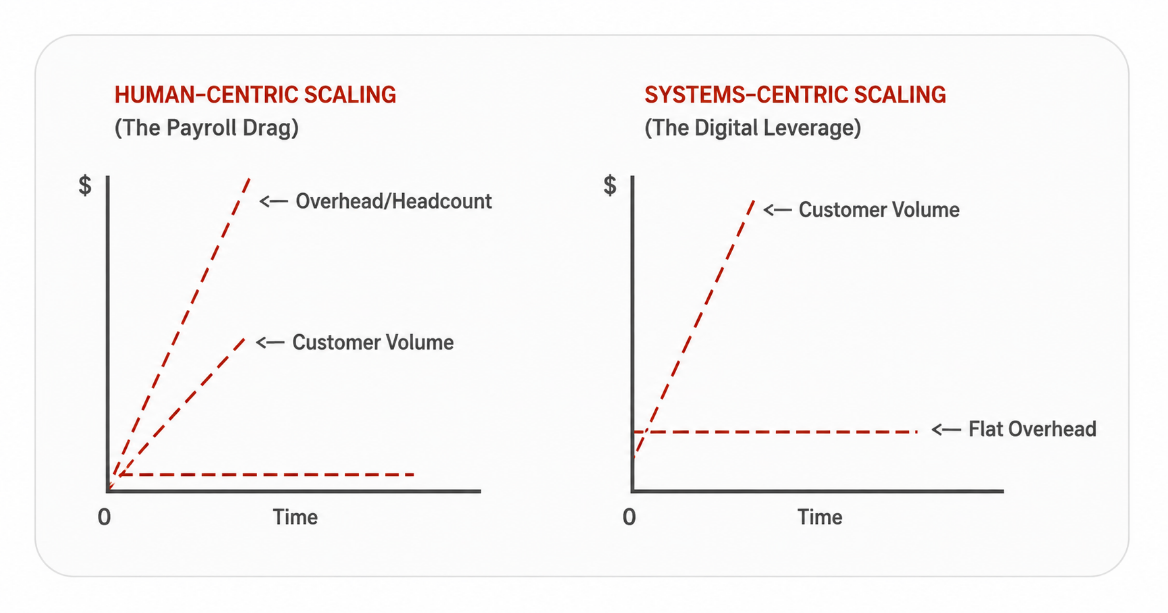
To understand how this operates, consider the structural difference between human-centric scaling and systems-centric scaling.
An increase in customer volume in a human-centric model requires an immediate, identical increase in personnel. Training time creates a three-to-six-month lag in productivity, and fixed overhead rises permanently.
On the other hand, with systems-centric scaling, workload is absorbed by a digital framework. As an example, there is no marginal cost associated with managing additional customer volume.
How does AI automation work?
Custom, automated AI workflows function continuously and process data in real-time across disparate internal systems and external data sources. This structure eliminates the delays, errors, and capacity limitations that occur when human staff are forced to act as data couriers between applications. In turn, your business operations are more productive, clients receive faster responses, and skilled staff are freed up for strategic tasks.
To build true leverage, it’s important to understand how these workflows operate within current operations. A successful implementation relies on three structural layers working in tandem:
- The Data Capture Layer: This layer uses intelligent document processing to read inbound emails, spreadsheets, and PDFs, extracting key text and customer intent without human intervention.
- The Logic and Processing Layer: This is where specialized AI models interpret the extracted data, reference your company’s operating rules, and determine the appropriate next action, such as drafting a response or validating an inventory status.
- The Integration Layer: This layer uses secure API connections to push the finalized information directly into your core systems, whether that is a customer relationship management platform or an ERP. No manual data entry required.
How do you build an AI-based transformation strategy for a small business?
An effective AI-based transformation strategy starts by auditing internal operations to identify opportunities such as highly repetitive or inefficient tasks. Once opportunities are identified, you are then in a position to automate specific, high-friction workflows.
This methodical approach ensures that you minimize workflow disruption while building your technical capabilities. Once the first automated sequence is stable and producing measurable time savings, you expand the digital framework to other areas of opportunity.
Identify the Friction
Audit every administrative task that is repetitive. Document the exact hours spent on manually managing these tasks.
Implement AI-Based Automations
Avoid overhauling the entire operation at once. Instead, automate the single workflow that causes the most manual drag and build a dedicated digital infrastructure for scaling around it.
As an example, determine what type of questions your customer service reps are consistently fielding, and develop an AI-based system that provides precise, timely responses.
Monitor Velocity
Measure the speed at which a core process is completed once your automation layer is active. Comparing this post-automation timeframe against your original manual baselines allows you to quantify the exact hours saved by your internal staff.
How do you calculate the financial cost of repetitive manual work?
To calculate the cost of manual drag, you multiply the weekly hours your staff wastes on repetitive manual tasks by their hourly compensation rate. This equation uncovers the hidden payroll expense currently being absorbed by non-billable, low-value processes. The table below outlines a standard baseline calculation for a mid-sized professional services or manufacturing organization.
| Department and Role | Manual Tasks Performed | Weekly Hours Wasted | Average Hourly Rate | Annual Cost of Friction |
|---|---|---|---|---|
| Professional Services Consultant | Extracting client intake data and drafting basic scopes | 6 hours | $75.00 | $23,400.00 |
| Manufacturing Sales Desk | Re-keying purchase orders from PDFs into ERP software | 8 hours | $30.00 | $12,480.00 |
| Operations Coordinator | Chasing missing client documents and updating spreadsheets | 10 hours | $35.00 | $18,200.00 |
By establishing a robust digital infrastructure for scaling, a business can redirect these savings into automating additional AI-based workflows.
Key Scalability Rules
- The Sustainability Rule: Growth that requires constant hiring is not sustainable in a high-velocity market.
- Human Talent Versus Machine Tasks: Digital workflows do not replace your experts. They remove the administrative work that prevents them from leveraging their expertise.
- The Multi-Year Efficiency Divide: The market is splitting between companies held back by their inability to scale without incurring additional headcount costs and those propelled by AI systems.
Summary
Incorporating AI-based workflows into your operations requires a shift in how you view your operations.
Automating manual, repetitive tasks allows you to grow your business without growing your headcount. This framework provides the operational capacity to scale up your business without taking on the fixed liabilities of unnecessary hiring.
Request Your Capacity Audit
Are you ready to see where your growth is stuck? Book a session with our team to identify the manual bottlenecks in your current workflow and see how much time your team can reclaim.

- The 2026 Guide to AEO for Manufacturers and Machine Visibility - July 16, 2026
- 350+ Chats a Month: How The Benefits Trust Launched a Scalable, AI-Powered Support Agent - June 29, 2026
- How SMEs Benefit from AI Automated Workflows - June 25, 2026